Mrs. Shears and the Owner and Pet Relationship of Wellington
The Curious Incident of the Dog in the Night-TimeThe relationship between Mrs. Shears and Wellington is defined by ownership and affection, then altered by Wellington’s death. The dog is not merely the victim whose killing prompts Christopher’s investigation: Mrs. Shears’s response to the loss, and the evidence linking the weapon to her gardening tools, make their bond a point where grief, suspicion, and Christopher’s search for reliable explanations meet.
The owner and her dog
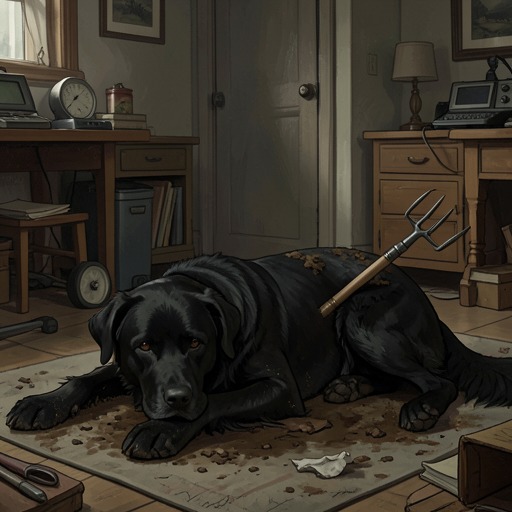
Wellington belongs to Mrs. Shears, who lives two houses to the left of Christopher’s home, across the road. Christopher knows her as a friend of his family. Wellington is a large poodle with curly black fur. His relationship with Mrs. Shears is introduced through these concrete facts of ownership and proximity, before the story turns the familiar dog into the center of a murder inquiry.
At the beginning of that inquiry, Christopher finds Wellington dead on Mrs. Shears’s lawn with a garden fork in him. He touches the dog and finds him still warm, then wonders who killed him and why. The scene changes the meaning of the ordinary neighborly relationship: Wellington’s death is both a loss for his owner and the unresolved event that Christopher decides to investigate.
Grief and misunderstanding
After Christopher pulls out the fork and holds Wellington, Mrs. Shears runs from her house and confronts him, believing he has done something to her dog. Her appearance in pajamas and a housecoat, with no shoes on, places her response in the immediate aftermath of discovering him. Christopher is frightened by shouting and cannot confidently read what other people mean through tone or expression. The encounter therefore presents two things at once: Mrs. Shears’s urgent reaction to her dog’s death and Christopher’s difficulty making sense of an emotionally charged exchange.
Later that evening, Christopher goes to Mrs. Shears’s door. She is at home with a mug of tea and watching a quiz program, but tells him that she does not want to see him then. Her refusal is a consequence of his earlier presence with Wellington, though Christopher does not treat the exchange as a reason to abandon his investigation. He instead tries to gather evidence without her help.
The shed and the investigation
When Christopher returns to investigate, he sees through a window into Mrs. Shears’s locked garden shed. A fork that looks like the one found in Wellington is on a bench, cleaned, with no blood on its spikes; a spade, rake, and long-handled clippers beside it have matching green plastic handles. These details lead him to infer that the fork belongs to Mrs. Shears. They do not establish that she killed Wellington: Christopher considers that possibility, then reasons that her angry reaction at the scene makes it less likely.
The locked shed gives the clue a second meaning. Christopher infers that the killer may have had access to the key, that Mrs. Shears may have left the shed unlocked, or that the fork may have been left in the garden. The evidence connects Wellington’s death to Mrs. Shears’s property, but leaves the killer unidentified. In the investigation, ownership is therefore both a fact about her bond with the dog and a practical lead that Christopher must interpret cautiously.
What Wellington’s loss reveals
Much later, Father explains the conflict that preceded Wellington’s death. After Christopher’s mother left, Mrs. Shears had helped Father and Christopher with cooking and cleaning and checked whether they needed anything. Father hoped she might eventually move in with them, or that he might move into her house. He says that he and Mrs. Shears argued repeatedly, and that after a particularly serious dispute she made him leave her home. His account places Wellington within a strained relationship between adults, but does not make the dog responsible for their conflict.
Father says that, during the final argument, he believed Mrs. Shears cared more about Wellington than about him or Christopher. The dispute continued in the garden, where Wellington was present; Father admits that, in anger, he killed the dog. This later confession resolves the mystery that Christopher’s early investigation could not: the fork’s connection to Mrs. Shears’s shed did not identify the owner as the killer. It was Father’s access to the dog and his conflict with Mrs. Shears that connected the murder to the relationship.
The contrast between Mrs. Shears’s care for Wellington and Father’s perception of that care as a rejection is central to how the relationship matters in the story. Wellington is Mrs. Shears’s companion and a beloved pet; in Father’s explanation, he also becomes the focus of resentment during a quarrel. The narrative does not reduce the dog to a clue: the investigation begins with his death, while the later account shows how an adult conflict turned against an animal who had been present in the garden.